

The housing and auxiliary equipment of Industrial Fans also need to be designed reasonably. The housing of the fan is usually made of lightweight but strong materials to reduce the overall weight and enhance the structural stability.
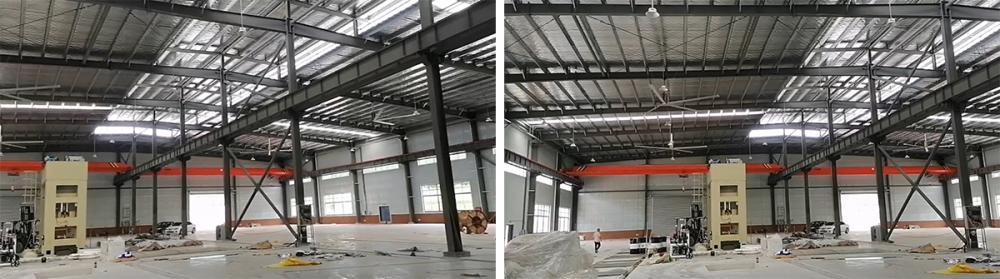
The design of the housing also needs to take into account the heat dissipation effect of the fan to ensure that it will not overheat during long-term operation. In addition, auxiliary equipment such as motors and transmission devices also need to be accurately calculated and selected to ensure that sufficient power and efficiency can be provided at low speeds.
Industrial Fans achieve low speeds and high air volume by creating strong airflow. They are usually driven by electric motors to generate rotational torque to make the blades rotate rapidly.
When the blades rotate, the centrifugal force generated will draw in the surrounding air and accelerate and compress it through the special design of the blades.
Driven by the blades, the high-speed compressed air is quickly discharged from the fan to form a strong airflow.